
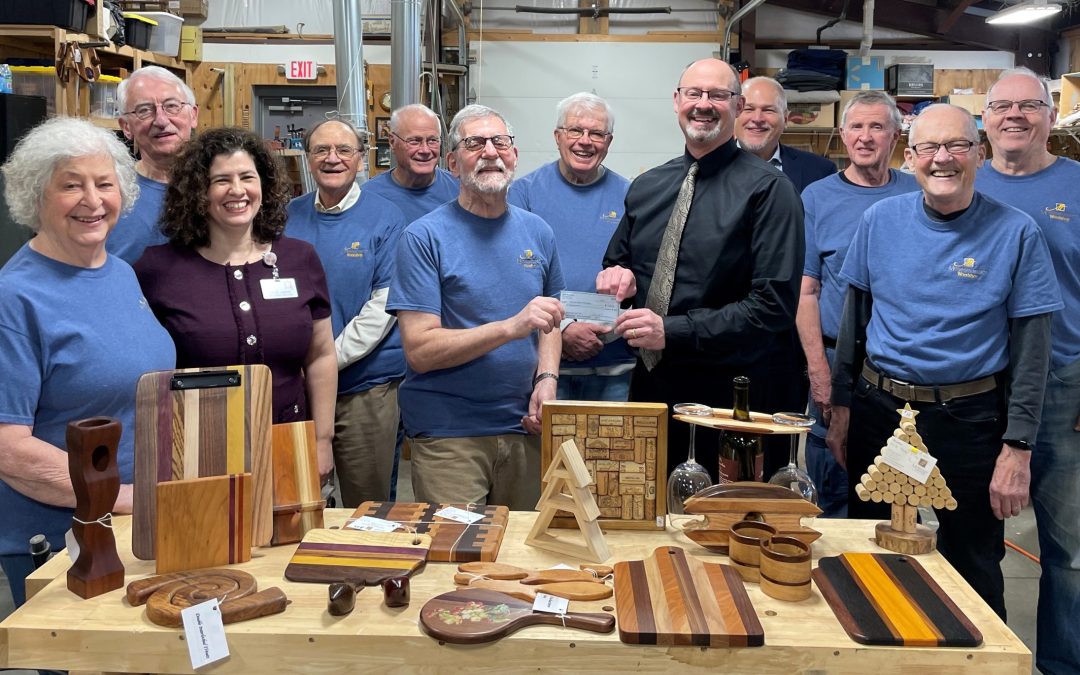
In MMC’s Woodshop, hands-on craftsmanship and shared purpose added up, becoming a $10,000 gift that supports neighbors through the Benevolent Care Fund.
On any given morning, MMC’s resident-run Woodshop hums to life with a steady rhythm. Sandpaper whispers across grain. A clamp tightens. A saw whirrs and buzzes. It’s careful work, done by hand and done together.
For many of the residents who gather there, the shop has become an anchor. “I told my wife I need to go to work…yeah, I know, that’s what it’s become,” Dale Matt (right) says with a grin. What began years ago as “three people in a garage” working shoulder to shoulder, has gradually grown into a fully equipped space shaped as much by relationships as by tools.
They don’t talk much about production goals. In fact, they’re quick to insist that selling is never the reason they come. “We don’t do our work just because someone needs it or for selling it,” Dale says. “We do it because we enjoy it.” The process matters – the feel of the wood, the challenge of a repair and the satisfaction of making something useful again.

And useful things are everywhere if you know where to look. The trash and recycling station in the Gallery Café. Bookshelves in the Fireside Lounge. A watercooler cover and an inlaid communion table. These are items residents, staff and visitors use every day, often without knowing who made them. And in the shop, that’s just fine. Pride here is quiet, measured in function rather than recognition.

Over time, small sales add up from craft shows, the Purple Robin in Lititz, and handcrafted gifts purchased by neighbors and friends. Through wine caddies, cork boards, refinished chairs and custom cutting boards, the broader community becomes part of the work. “Our ability to donate comes entirely from the people who buy our work,” says Herman Bontrager (left). “Without them, we wouldn’t be able to contribute.”
Then came a moment of realization. After years of steady making and modest selling, the group looked at their account and paused. “We realized that we had too much money,” Mark Hirschman (right) says. “And the Manor has been good to us, so we decided to give back to the Manor.”
Their $10,000 gift to the Benevolent Care Fund didn’t come from a campaign. It came from an accumulation of hours, of careful work and shared purpose. It came from a group that values making things last, whether that means tightening a loose joint instead of replacing a chair or carrying forward the work of someone no longer at the bench. Even now, pieces crafted by former members still sell, a reminder that the shop holds more than tools. It holds continuity.


It also holds connection. “I like all these people,” says Martha Bochenko (left), who first came to learn how to re-cane a single chair and stayed for the company as much as the craft. “And I wouldn’t know any of them if I didn’t come here.”
In that way, the Woodshop’s gift feels less like an endpoint and more like an extension of the work. The same steady and attentive care that goes into shaping wood now reaches beyond the shop walls. It supports neighbors who rely on the Benevolent Care Fund to remain part of this community they call home.
Something made by hand carries a story. In the Woodshop, those stories are built piece by piece, then quietly passed on, reaching people whose lives are changed by the care put into them.
— Read MMC’s complete 2025 Annual Impact Report on our Publications page (found below our Pursuits Community Lifestyle Magazine).