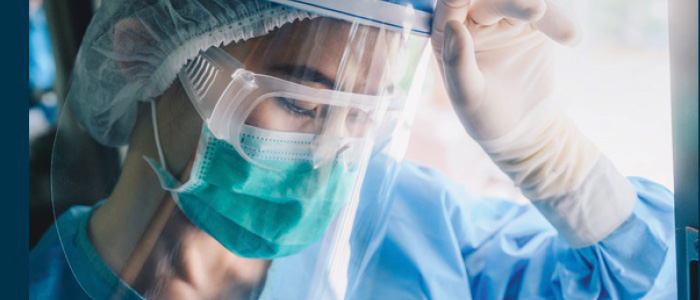
The following is an honest, yet raw account from an anonymous Moravian Manor Communities’ team member, highlighting what it’s been like working as a front-line employee in a COVID-19 Red Zone.
Your life at work is now more emotionally, mentally, and physically draining than it’s ever been. As you enter the building, sanitize your hands. Screen in and get your temp checked. Sanitize your hands. Clock in. Sanitize your hands.
You arrive on your unit. Sanitize your hands. Label and put on your N95. Sanitize your hands. Clean and put on your goggles. Sanitize your hands. Put on the gown.
Within five minutes you are drenched with sweat. You will remain wet for the next 8 to 9 hours. Perspiration runs down your face, but you can’t wipe it away. It runs in your ears and in your eyes. Your underwear is saturated.
On the first day, I didn’t label my mask before putting it on. A co-worker writes my name on for me. She misspells it. I tell her to let it that way. We need something to laugh at.
What to do if you have an itch, or need to blow your nose? It’s a ten-minute process just to remove the mask and put it back on again. Well, while it’s off, might as well get a drink too. Stay hydrated. If you’ve been trying to lose weight, you may lose it now…in water weight. Except you’ve been given chocolate to keep your spirits up. Might as well eat a couple pieces while your mask is off. Wash your hands. Then you go to put your mask back on and the elastic snaps and breaks. What?! You hold it in place to go get another one to replace it. Wash your hands.
Ugh! A resident has pulled the air circulation vent from the window and it’s now blowing on the living room chair instead of out the window.
So many co-workers on other units feel for you. They know it could have just as well happened on their unit. They take the time to write messages letting you know they are thinking of you. So sweet and appreciated!
You are told how beautiful you are. The gown is lovely. Please don’t touch the gown. Wash your hands.
The bridge of your nose is red and sore from the N95. Do pressure sores on employees get reported to the state? A skin condition flares up from the warm, moist environment. You get a corneal ulcer, and then another one, from sweat running in your eyes. A day after having a cracked tooth fixed, you read a news article on dentists fixing a record number of cracked teeth attributed to pandemic stress.
Residents that understand the seriousness worry they will get it and die. They worry for the ones that tested positive. They want it all just to end.
Some residents have no idea what is going on. They just know they can’t see their spouse, or their children. They hate it and just want to go home. They’re getting out of here. Yeah, I want to go home too.
Fortunately, the two residents that tested positive for the virus were asymptomatic. How can they have the virus? There’s no fever. Wash your hands. When will their symptoms start? Check their vitals every shift. Wash your hands. Oxygen levels are at 97 and 98%. So confusing. Wash your hands. Check everyone’s temps every shift. Wash your hands.
We are being “so mean.” They don’t want to stay in their rooms. Wash your hands. Their mask immediately comes off. Wash your hands. They don’t know they have tested positive for a virus that has already killed many people all over the world.
Your shift ends and you do get to go home. Wash your hands.
Ahhh! Strip off the drenched uniform. Get in the shower. Wash it all away. My daughter notices the red line across my forehead from the goggles and the marks from the mask. I assure her they will be gone by morning. Get a good night’s sleep. Tomorrow, you get to do it all over again.
Moravian Manor Communities is ever grateful for our dedicated team during these trials and tribulations. It’s their level of commitment that makes our community a leading health care provider in the Lancaster area.
Please take a moment to watch this important update from David Swartley, President and CEO of Moravian Manor Communities. You can keep up with all of our COVID-19 updates by clicking here.
It’s Fire Prevention Week, commemorating the Great Chicago Fire that began on October 8, 1871 and caused devastating damage. This horrific conflagration killed more than 250 people, left 100,000 people homeless, destroyed more than 17,400 structures, and burned more than 2,000 acres of land.
Fire Prevention Week History
Since 1922, The National Fire Protection Association (NFPA) has sponsored the public observance of Fire Prevention Week. In 1925, President Calvin Coolidge proclaimed Fire Prevention Week a national observance, making it the longest running public health observance in our country. During Fire Prevention Week, children, adults and teachers learn how to stay safe in case of a fire. Firefighters provide lifesaving public education in an effort to drastically decrease casualties caused by fires.
“Serve Up Fire Safety in the Kitchen” – 2020 Theme for Fire Prevention Week
Cooking is the #1 cause of home fires and related injuries, and unattended cooking is the primary cause of fires in the kitchen. With the holidays approaching, it’s important to know that Thanksgiving is the leading day for fires involving cooking equipment. Follow these helpful hints to stay safe in the kitchen:
Never leave the kitchen when boiling, broiling or frying food.
If you are simmering, baking or roasting food, check it regularly and stay inside the home.
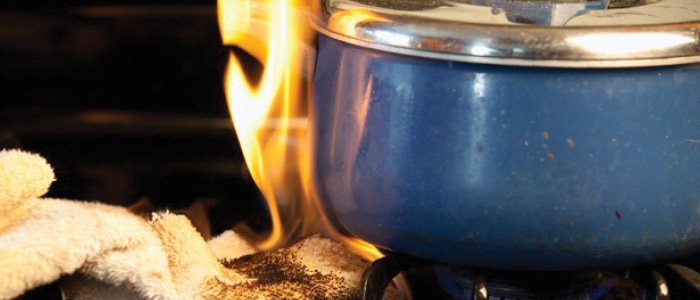
Always keep a lid nearby when cooking. If a small grease fire starts, slide the lid over the pan and turn off the burner.
Turn off the stove when finished cooking.
Keep combustibles away from the stove. Towels and oven mitts often start fires.
A common cause of fires is pizza boxes left on top of stoves…dogs jump on stoves to investigate and turn the stove dial on.
Fire Escape Plan – Be Prepared!
Newer homes burn faster than older homes. It is imperative that you exit the home quickly in the event of a fire.
Draw a map of all rooms in your home.
Mark 2 exits from each room (usually a door and a window). Mark a path from each exit to the outside.
Include the location of all alarms in your house.
Choose an outside meeting place to meet up.
Call 911 from outside the house.
Practice twice a year.
Smoke Alarms – Providing a Life-Saving First Alert!
Smoke alarms detect and alert people to a fire in the early stages.
Smoke alarms can mean the difference between life and death in a fire.
Working smoke alarms cut the risk of dying in a home fire in half.
Install smoke alarms in every sleeping room, outside each separate sleeping area, and on every level of the home, including the basement.
Test smoke alarms at least once a month using the test button.
Make sure everyone in the home understands the sound of the smoke alarm and knows how to respond.
Smoke alarms need to be REPLACED at least every 10 years.
Q&A with Gary Gaissert, Moravian Manor Communities, VP of Operations
Q:What training is done at Moravian Manor Communities with regards to fire and emergencies?
A: All Life Plan Communities are mandated to have an emergency preparedness plan in place that includes processes and procedures for both residents and staff. Here at Moravian Manor Communities (MMC), we focus on staff training and responses to all types of emergencies including fire. MMC staff are well trained to respond promptly and effectively to any emergency situation to provide essential services to protect the people and property under its care. We utilize the Incident Management System, which clearly identifies staff responsibilities and assignments enabling us to interact and communicate with the operations of all outside support agencies (fire/police/ems/etc.). Every staff member is required to be recertified annually in the proper use of a fire extinguisher. (Incidentally, we have partnered with Warwick Emergency Services Commission in helping fund the purchase of extinguisher training equipment.) Throughout the year, there are multiple practice drills in all levels of care. We regularly check/test all emergency notification and sprinkler systems to ensure they are in proper working order. In addition, our staff interacts with the local fire and emergency management staff to continually update our response plans. Stay safe!
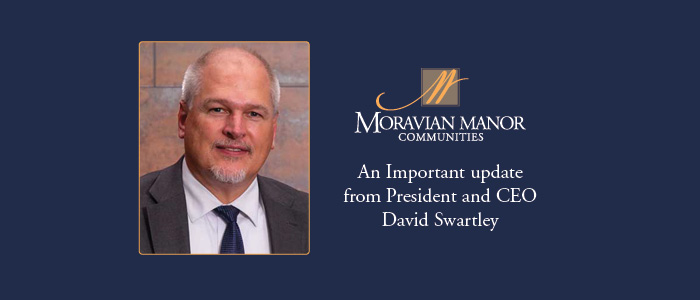
From: David Swartley, President/CEO Date: October 6, 2020 RE: Coronavirus (COVID-19) Update #26
As I’ve discussed in my earlier updates, Moravian Manor Communities (MMC) has been rigorously following all infection control protocols stipulated by the PA Department of Health and the U.S. Centers for Disease Control (CDC) for dealing with the new Coronavirus.
As you are aware, two weeks ago, we had two residents, and one staff member test positive for COVID-19. We immediately moved the unit with positive residents to a “Red Zone.” Red Zone precautions provide the highest level of protection for both the residents and the staff serving them.
The good news is that after our fourteen-day wait, none of the infected individuals developed any symptoms, and all are fine. Our team is extremely grateful that our residents and staff remained safe and are well.
The positive tests meant that we needed to test all staff for two consecutive weeks. This fourteen-day period must yield 100% negative results for residents and staff. Both weeks testing came back 100% negative! The two weeks of negative testing means that we return to the weekly twenty-five percent testing of our staff. Per the Pennsylvania Department of Health, we can resume scheduled visitation two weeks after our universal testing comes back negative. We anticipate scheduled visits to resume on October 20; assuming there are not more positive cases. Again, a reason to celebrate!
While we are grateful for our healthy residents and staff, last week was a stark reminder of the danger of the virus. As our nation followed our President’s illness and recovery, it was a poignant reminder that viruses do not discriminate.
Our message has not changed since early in the year. Wash your hands, wear your masks, and social distance. If you can avoid group settings, it is wise to do so. While Pennsylvania and Lancaster County cases seem to be under control, we are entering the time of year to spend more time indoors and less time in the fresh air. Many medical experts are concerned about another outbreak as we move through the fall months and into the winter months. Our simple actions can keep us safe and also keep our businesses open.
Thank you for your continued support of our ministry at Moravian Manor Communities. While we come from all walks of life, it is gratifying to see the residents of MMC truly adopt a community spirit as we move forward!
For those of you seeking additional information, continuous updates are available at the following websites:
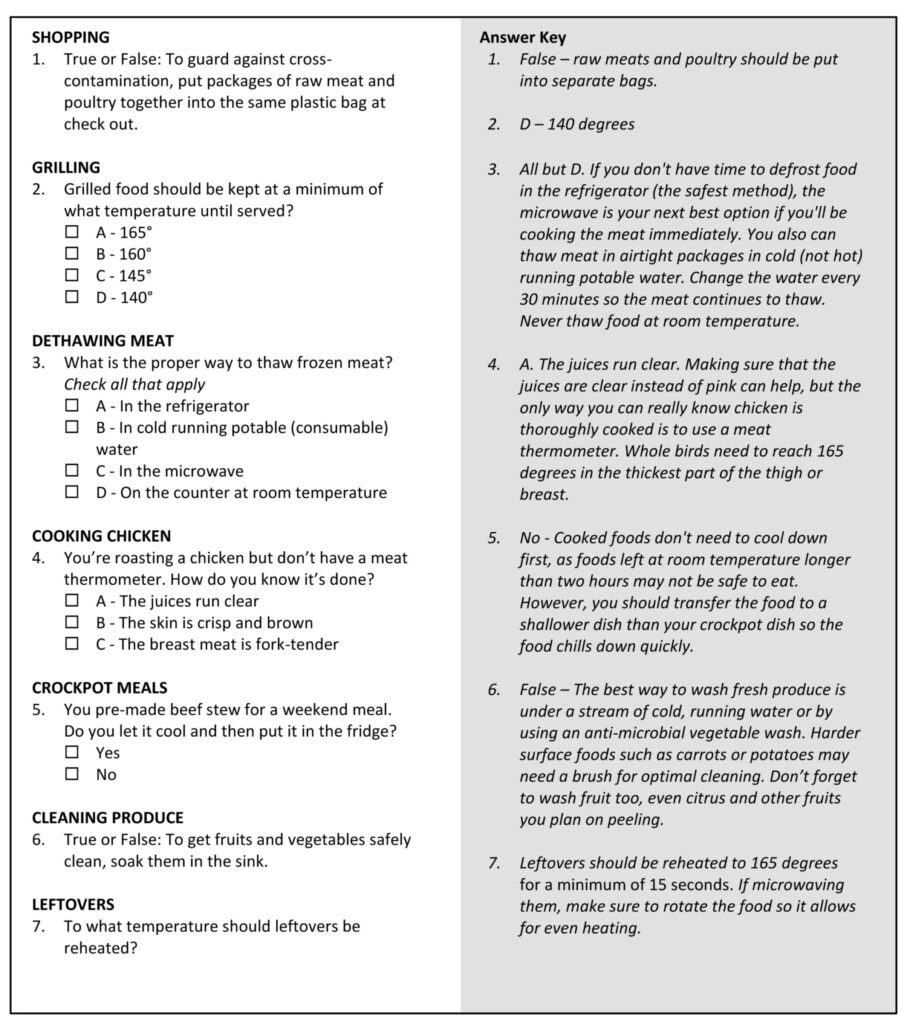
We all know that food safety is important. There are processes and procedures at the farms, packers and processors, restaurants and food stores. But we play a key role ourselves for ensuring the food we prepare is safe to eat. Take this short quiz to see if you know some of the basics.
Did you pass the quiz? If you scored 100%, you’re a food prep pro. Even if you scored low, you just brushed up on your food safety tips by taking this quiz.
To advance your food safety knowledge, Chef Derek from Moravian Manor Communities shares some tips below from the foodservice industry that also apply to food safety in your home.
Chef or Home Cook, The Rules Still Apply
Safe cooking, serving, storing, and rotation of food products are all an integral part of keeping our food safe to eat. As a home chef who prepares many meals for family and friends, you too should follow some hard and true food safety guidelines.
Pre-washing produce is a must for food safety. Remember, most of these products grow in the ground or are treated with chemicals to preserve freshness. Therefore, they must be washed prior to cutting or using. Salmonella and listeria are just a few foodborne illnesses that can be contracted from dirty or unwashed produce. Don’t worry about re-washing pre-washed greens. Doing this can cause more harm than good because you could introduce bacteria to the greens from your sink and counters.
Cold foods must be held at 40 degrees or below and hot foods must be held at 140 degrees or above once cooked and awaiting to be served. Most foodborne pathogens grow when the temperature is between 41 degrees – 139 degrees.
Prevent foodborne illnesses by:
Proper handwashing
Cook food thoroughly
Prevent cross-contamination by using one cutting board for fresh produce and another for raw meat, poultry and seafood.
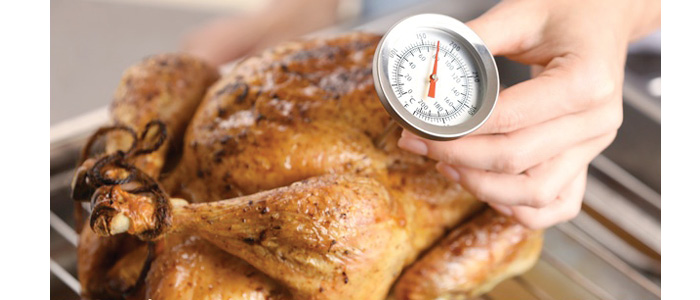
Use food thermometers to gauge internal temperatures:
Fish – 145 degrees
Whole meats – 145 degrees
Ground meats – 155 degrees
Poultry – 165 degrees
Do not put hot food directly into the freezer. By doing this, you risk increasing the temperature of other foods nearby already frozen, which could lead to bacterial growth. Allow enough time for hot food to cool slightly before placing in the fridge or freezer.
When pre-seasoning or marinating meats before cooking, put them in a container or sealed bag and place in the refrigerator. Pull it out of the refrigerator when you are ready to cook and dispose of any liquids no used; do not reuse marinades or add uncooked liquids to cooked foods as this can add unwanted bacteria to the food about to be consumed.
Use airtight storage containers to store leftovers for in the fridge or freezer. Properly sealed containers help keep out bacteria and prevent odors impacting other food in your refrigerator.
When defrosting meat, the best options are to either defrost meat in the fridge, under cold running potable (consumable)water, or in the microwave. Leaving it on your kitchen counter to defrost at room temperature can take hours and by then a number of bacteria have made the meat unsafe to eat, even after it’s cooked.
We hope you find this helpful for consuming, cooking, and storing foods safely. Bon appétit!