From: David Swartley, President/CEO Date: November 13, 2020 RE: Coronavirus (COVID-19) Update #29
I am writing to give you an update regarding the COVID-19 virus. The fall surge is upon us. It is time for all of us to take renewed precautions. I share some of our most recent testing data below:
Universal testing from this past week resulted in 100% negative tests for both our employees and residents. We celebrate this news!
The Founders Campus residents who tested positive for COVID-19 are feeling well, and their quarantine period will be up in a couple of days.
An additional resident on the Founders Campus tested positive for COVID-19. The resident is currently quarantined at home and feeling fine.
Outside of our universal testing, two employees had community exposure and are self-quarantined at home. Neither has had serious symptoms.
Several other employees are presently not permitted at work due to possible community exposure.
Lancaster County is above the five percent positivity rate. This high rate means that we will need to continue universal testing every week.
While our current situation at Moravian Manor Communities is excellent, the community spread rate is multiplying. Lancaster General had sixty-four COVID-19 patients as of yesterday. Twelve of these patients were on ventilators. These statistics should get everyone’s attention.
Our COVID-19 Task Force met this morning and discussed visitation and residential living activities. Following is a summary of the decisions made this morning.
The woodshop will reopen for two residents at a time. They must be wearing masks while in the woodshop.
The Smartfit Studio will reopen for two residents at a time. Please disinfect after using the equipment.
The residential living beauty shop will reopen. This temporary location serves one resident at a time. We also decided that this shop will remain open in the coming months unless a resident using the beauty shop or a beautician tests positive.
Some small groups, such as Bible Study and Life Writing, may use the Fireside Lounge. Masks are required.
The Owl’s Nest has begun to screen any guests eating at the restaurant (questionnaire and temperature check).
Garden Court Dining will continue to be available only to our Garden Court Apartment Residents. Please make use of our take out service.
Maintenance work orders will remain “essential only” for the next two weeks. Housekeeping services will also remain discontinued during that time.
PLEASE PUT ON A MASK if the staff is coming to work in your residence. We have instructed our team members not to enter your home if you are not wearing a mask.
Our task force is very concerned about the community spread and the holidays. Again, I encourage you to plan your events very carefully. Think through what the days will look like for you? Make any changes you can to assist in stopping the spread. These decisions are difficult. Yesterday, Pennsylvania and Lancaster County reached an all-time daily high of positive cases at 5,531. Lancaster County had 247 positive cases. We need to be alert.
It is your simple actions that will keep both you and your loved ones safe. Wash your hands, wear a mask, and social distance. Social distancing will be increasingly difficult with the arrival of the holidays and cold weather. Thank you for doing your part to keep Moravian Manor Communities a safe place to live and work.
I also encourage you to continue to get out and walk. Yes, it is a little cooler, but you should be OK with a jacket and hat (watch for wet leaves on the sidewalks). I recently saw a quote that read, “Living through a pandemic is like being sixteen again. Gas is cheap, and I am grounded.” There is some truth in that statement! Stay well, keep each other in your prayers, and make wise decisions.
For those of you seeking additional information, continuous updates are available at the following websites:
From: David Swartley, President/CEO Date: November 3, 2020 RE: Coronavirus (COVID-19) Update #28
Happy Election Day! I am sure that most of us concur that it is time to have the election “over.” The fact that Pennsylvania is a “swing state” certainly has put an added burden on all of us. Having the pandemic as a constant cloud over us is also emotionally wearing. Please find effective ways to provide for self-care.
I am writing to give you an update regarding the COVID-19 virus. As I shared with you last week, it appears the fall surge is upon us. I share some of our most recent testing data below:
• Two weeks ago, four employees tested positive. As directed by the Pennsylvania Department of Health (DOH) and the U.S. Centers for Disease Control (CDC), team members must self-quarantine for up to 14 days.
• One week ago, three additional employees tested positive. Again, team members must self-quarantine for up to 14 days.
• On Sunday, November 1, a resident on Herrnhut Personal Care tested positive for COVID-19. At the time of this writing, the resident is asymptomatic.
• On Sunday, November 1, we learned of a couple residential living residents on the Founders Campus tested positive for COVID-19.
• Our testing from October 29 and October 30 yielded no further positive tests from residents or employees. (great news!)
Reading the above data points out that we need to maintain and enhance our vigilance. Regrettably, the activity has resulted in another pause in our visitation. The increased viral activity also means that we are universally testing all employees (and most residents) until we have two weeks of no positives. Management of the pandemic is an emotional strain for all residents, staff, and family members. At our COVID-19 Task Force meeting on Monday, November 2, we also decided to announce the following guidelines to stop any further spread.
• Garden Court Dining will only be available to our Garden Court Apartment residents. Please make use of our take-out service.
• Any activity groups that meet in the Garden Court area or the Woods Apartment building are restricted from meeting for an initial period of two weeks.
• Maintenance work orders will revert to essential only for the next two weeks.
• The Beauty Salon services for RL are on hold for the next two weeks.
• PLEASE PUT ON A MASK if the staff is coming to work in your residence. We have instructed our team members not to enter your home if you are not wearing a mask.
As the pandemic continues, it becomes even more challenging to comply with restrictive guidelines. As we approach the holidays, I would encourage you to plan your events very carefully. Think through what the days will look like for you. Make any changes you can to assist in stopping the spread. I understand and empathize that these decisions can and will be excruciating.
Nevertheless, have these conversations with your family and friends today! It is your simple actions that will keep both you and your loved ones safe. Wash your hands, wear a mask, and social distance. Social distancing will be increasingly difficult with the arrival of the holidays and cold weather. Thank you for doing your part to help keep Moravian Manor Communities a safe place to live and work.
For those of you seeking additional information, continuous updates are available at the following websites:
There is saving and then there is investing. The big differences between them are what type of account you use to hold your money and how long it will be there.
Saving is what you do with money you will need to pay for short term goals (goals that occur in the next five or so years). This money should be placed in an account that’s easily accessible and safe such as a savings account or a certificate of deposit.
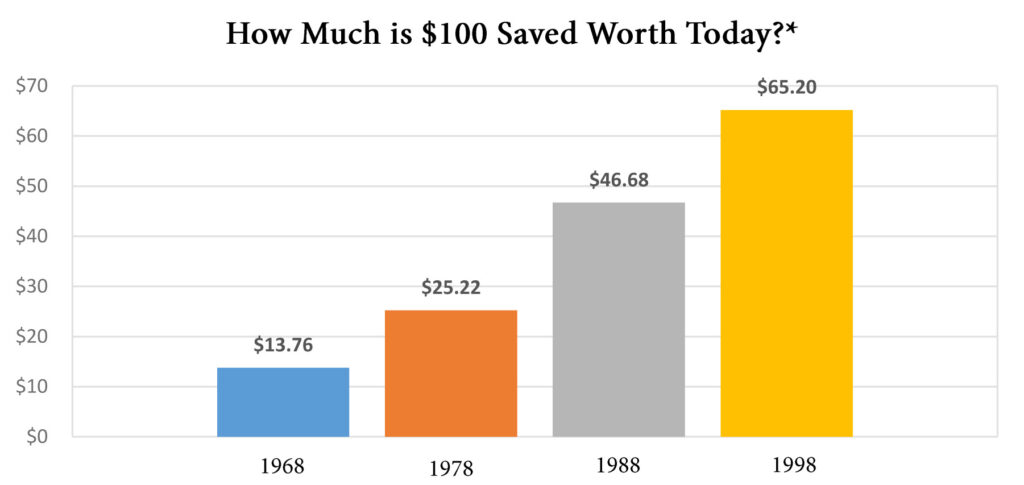
Investing is what you do with money you’ll need for long-term goals such as retirement. In this case, you should make growth of your money the number one priority. Growth of your money is important because it needs to outpace inflation, which erodes the purchasing power of money. Let’s look at an example. If you put $10 under your mattress today and the inflation rate is 2%, this time next year that money will only buy $9.80 worth of goods and services compared to last year. Look at the chart below to better understand how decades of inflation can affect your savings.
In order to outpace inflation, you must invest your money in the stock market. In most retirement programs, mutual funds are the investment vehicle of choice. A mutual fund is a group of different investments packaged into a single “basket.” These baskets may invest in individual stock, bonds, cash type investments or combination of all three. Mutual Funds have different names depending upon the investment company that offers them as well as their strategy. Look for the mutual fund’s informational page describing its strategy, how it has performed over time as well as its fees. Pay particular attention to the expense ratio (the cost you pay to participate in the mutual fund as a percentage of how much of the fund that you own) as you decide which mutual funds are right for you.
It’s never too early to get started. Even if you only have a little money to invest, get started now because compound interest will begin to work its magic. Compound interest is like a runaway snowball of money that grows larger and larger as it rolls along. The sooner you get that snowball rolling the better.
From: David Swartley, President/CEO Date: October 22, 2020 RE: Coronavirus (COVID-19) Update #27
As I’ve discussed in my earlier updates, Moravian Manor Communities has been rigorously following all infection control protocols stipulated by the Pennsylvania Department of Health (DOH) and the U.S. Centers for Disease Control (CDC) for dealing with COVID-19. Despite our best efforts, recent testing confirmed on October 21, 2020, that four staff members and as well as a contract health care provider have tested positive for COVID-19.
While this is certainly not the news I desire to share, it is not surprising considering the recent worldwide virus surge. The good news is our four staff, and our external health care provider are all asymptomatic. Again, this means that all five healthcare workers are well at present. They will all need to self-quarantine for fourteen days. All cases were identified by proactive weekly testing that has been ongoing every week at Moravian Manor Communities.
Unfortunately, this also means we are required to halt external visitation in our care areas. Our visits had just restarted earlier in the week. Stopping visitation is tough news for our residents, resident family members, and staff. These positive tests also mean that all staff will need to be tested in the next two weeks (and ongoing until we have no positive test results for two weeks).
Moravian Manor Communities always has had a robust infection control system in place. In recognition of our team’s work under the direction of Dr. Lynn Swisher, our skilled nursing center was one of four facilities (in Pennsylvania) DOH selected to work on the antibody testing program. Ironically, our team was meeting (via telephone) with the Pennsylvania Department of Health regarding the antibody testing program when we received word of our positive test results.
The staff members who have tested positive all work in our care areas, so there is no known exposure to our Residential living areas. As I have stated numerous times over the past number of months, it is your simple actions that will keep both you and your loved ones safe. Wash your hands, wear a mask, and social distance. Social distancing will be increasingly difficult with the arrival of the holidays and cold weather.
Thank you for doing your part to keep Moravian Manor Communities a safe place to live and work.
For those of you seeking additional information, continuous updates are available at the following websites:
Converting Favorite Recipes for Heart Healthy Diets, from Sodexo USA
Autumn is upon us and colder days call for hearty soups and meals. Sumptuous foods don’t have to be bad for your though, it just takes some re-imagining. However, it can seem intimidating, or a daunting task, to adjust your recipes when shifting to a heart healthy diet. Hopefully, after reading this, you will have learned some easy tricks to reduce or eliminate things like fats and salt from your favorite recipes. And discover a favorite recipe converted to be heart healthy for you!
One of the first things to understand is that cooking is both an art AND a science. The science of cooking explains how things work the way they do, and the art of cooking is being able to manipulate or finesse recipes to meet the needs of your particular palette. When it comes to the science of flavor, there are four categories of ingredients that come into play:
Fats
Salt
Alcohol
Acidity
These four types of ingredients are known as “flavor enhancers” – they help to turn bland foods that taste flat into foods with rich flavors. We’ll focus on three of these ingredients in this article.
FATS
The first one we will focus on is fats. In some cases, it is difficult to entirely eliminate fats from recipes. Our best plan of action is to reduce the amount of fats we use in recipes and replace them with heart healthy alternatives. In most savory applications, such as sautéing, you can replace butter with smaller amounts of heart healthy fats like olive or sesame oil. In some sweet applications, such as baking a cake, if a recipe calls for oil, you can substitute in an equal amount of applesauce to maintain moisture in the batter and eliminate fat content.
SALT & ACIDITY
The second, and perhaps most important, ingredient to focus on in heart health is salt. Salt is one of the easiest ways to “add flavor” to recipes, but is an ingredient that causes issues in many diets. If you want to eliminate added salt entirely from your diet, the easiest way to do so is to utilize acidity as a new flavor enhancer. Now, substituting the acid for salt is a scientific answer, but how you choose to use acidity is an art, as using too much can easily overwhelm the dishes you prepare. As with many ingredients, your best bet will be to use a little, then taste the food and add more if necessary. Here are some general guidelines for utilizing acidity, but of course these are just guidelines, and you can play around with the ingredients to determine what works for you.
Lemon Juice: this is one of the most widely used, and readily available, acidic items in the standard kitchen. Think of the lemon wedge served with seafood when you go out to eat. Just a little splash will help brighten flavors. Lemon juice is most helpful with seafood, hearty green vegetables, and some broth-based soups.
Apple Cider Vinegar: this is another widely utilized ingredient in kitchens. This works best with pork chops, pork tenderloin, pork shoulder, and light green vegetables like cabbage or lettuce.
Red Wine Vinegar: this is a rich and robust vinegar. This works well with beef, chicken thighs, white beans, chickpeas, and hot vegetable preparations such as mixed vegetables, brussels sprouts, or broccoli.
Champagne or Sherry Vinegar: these are both lighter vinegars, with slightly different flavor profiles, but work fairly well interchangeably. These work well with chicken breasts, mushrooms, and leafy greens (including drizzled on salads).
Please note: replacing salt with acidity works great in savory applications. However, you will notice that a lot of baking recipes call for salt as an ingredient. In most recipes, it is difficult to simply remove the salt without affecting the flavor of the finished product. In some sweet recipes, you can help alleviate this issue by replacing the salt with vanilla extract, but you will need to use a double measure of vanilla versus salt. However, if you are baking something like bread, there is no easy replacement, and you may have to simply leave the salt out of the recipe and deal with the resulting product.
The final piece of advice that I want to provide is this: sometimes, the easier way to intensify flavors for some foods is to roast them, and this works especially well for foods that have a high water content. For instance, when I make mushroom soup (either broth-based or creamy), I always toss the mushrooms with some olive oil, Dijon mustard, paprika, parsley, and chives, then spread on a roasting pan and roast in a 375 degree oven for 25-35 minutes, until most of the moisture is baked out, then put the mushrooms into the soup and allow them to slightly rehydrate, which in turn flavors the broth.
Not every ingredient or every method will work for everyone, it depends on your palette and your food preferences. But this should give you some possibilities and flexibility when it comes to cooking at home on a Heart Healthy Diet. Best of luck, and good eating!
Heart Healthy Creamy Turkey & Wild Rice Soup
1 tablespoon extra-virgin olive oil
2 cups sliced mushrooms, (about 4 ounces)
¾ cup chopped celery
¾ cup chopped carrots
¼ cup chopped shallots
¼ cup all-purpose flour
¼ teaspoon freshly ground pepper
4 cups reduced-sodium chicken broth
1 cup quick-cooking or instant wild rice
3 cups shredded cooked chicken, or turkey
½ cup reduced-fat sour cream
1 teaspoon lemon juice
2 tablespoons chopped fresh parsley
Directions
Step 1: Heat oil in a large saucepan over medium heat. Add mushrooms, celery, carrots and shallots and cook, stirring, until softened, about 5 minutes. Add flour and pepper and cook, stirring, for 2 minutes more.
Step 2: Add broth and bring to a boil, scraping up any browned bits. Add rice and reduce heat to a simmer. Cover and cook until the rice is tender, 5 to 7 minutes. Stir in turkey (or chicken), sour cream, lemon juice and parsley and cook until heated through, about 2 minutes more.